
Engineering Case Studies
How ideas become structured, usable software.
Explore the product decisions, technical approaches, development challenges, and lessons behind selected IKECOZ projects.
Our current Case Studies document internal products and experimental builds while the IKECOZ client portfolio continues to grow.
Featured studies
Internal products and prototypes, documented honestly.
Current Case Studies focus on IKECOZ engineering work — not invented client logos or commercial metrics.
Featured case studies
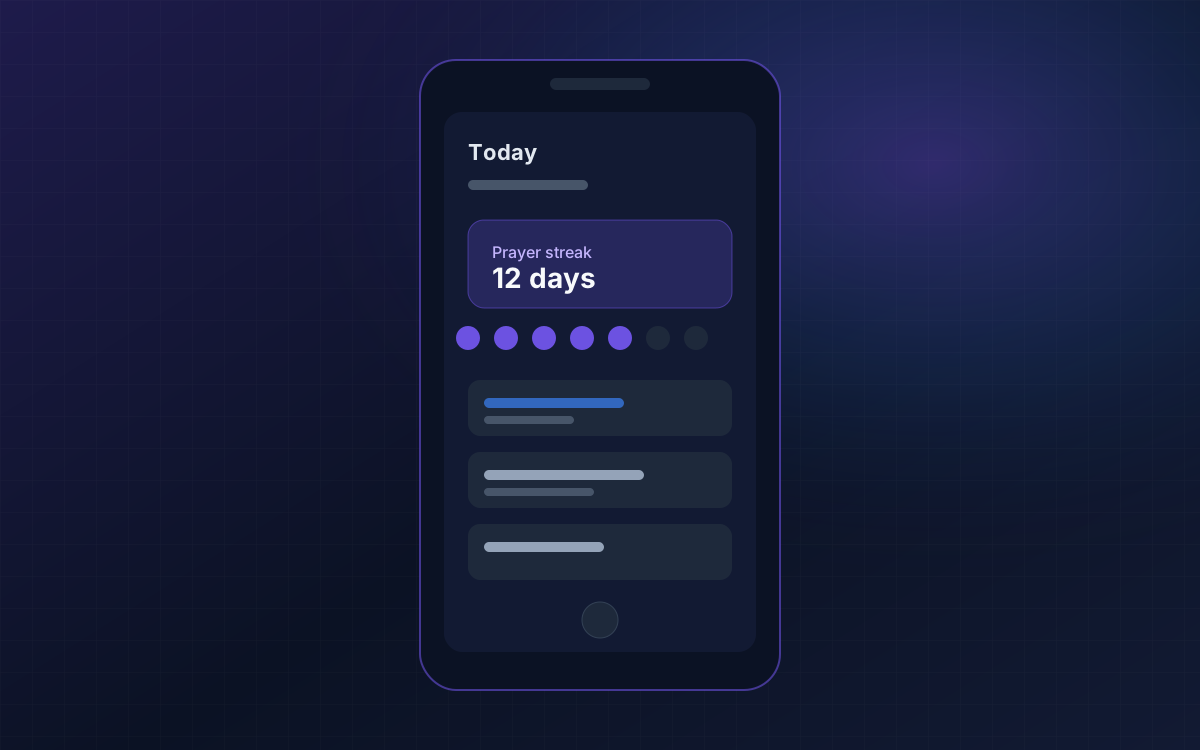
PraySync
How IKECOZ approached a Flutter-based prayer application as an internal product — building screens, resolving analysis issues, and testing across browser and Android environments.
- Flutter
- Dart
- Mobile UI
- Cross-platform testing
Creatiq
How IKECOZ prototyped a Node.js and Gemini-assisted creative tool — environment configuration, server setup, and iterative feature testing without overstating production readiness.
- JavaScript
- Node.js
- Gemini API
- Environment configuration
What you can evaluate
What our Case Studies show.
Engineering transparency — how problems were understood, built, tested, and learned from.
What our case studies show
Problem analysis
What need or workflow gap the work responds to — stated without invented market claims.
Product thinking
How user flows, scope, and experience goals shaped implementation choices.
Technical planning
Architecture and tooling selected for the project type, team, and constraints.
Interface development
How screens, states, and interaction feedback were built and refined.
Integration work
How external services or APIs were connected with careful configuration handling.
Debugging
What failed, how it was investigated, and what changed to resolve it.
Testing and iteration
How analysis, manual testing, or validation loops informed the next step.
Documentation and future planning
What was learned and what remains intentionally unbuilt until verified.
Engineering approach
How IKECOZ documents project work.
Aligned with Services and Products processes — focused on evidence and maintainability.
Engineering approach
01
Understand the need
Clarify the user problem, workflow friction, or prototype hypothesis before choosing tools.
02
Define the experience
Describe intended users, core flows, and what successful interaction looks like.
03
Identify technical requirements
Choose platforms, integrations, and quality gates appropriate to the scope.
04
Choose an architecture
Keep the structure honest — only include infrastructure that exists or is verified.
05
Build in controlled stages
Ship meaningful slices, resolve issues, and avoid premature production claims.
06
Test and resolve issues
Use analysis, manual testing, and targeted debugging to confirm behaviour.
07
Document the result
Capture outcomes, lessons, and current status for transparent engineering review.
08
Plan future improvements
List next steps as possibilities — not as completed features.
Outcomes and learning
Outcomes beyond commercial metrics
IKECOZ evaluates projects by whether the core workflow works, whether the architecture can extend, whether issues were resolved systematically, and whether the work is ready for its next honest development stage.
Outcomes and learning
- Whether the core workflow works in tested environments
- Whether the architecture can be extended without a rewrite
- Whether the interface is understandable for intended use
- Whether errors were investigated and resolved systematically
- Whether the codebase remains maintainable for the next iteration
- Whether the project status is accurately represented
Related services
Case Study work connects to delivery capabilities.
Related services
Mobile App Development
Cross-platform and native-oriented mobile product delivery.
SaaS Product Development
Multi-user product foundations and platform thinking.
AI and Business Automation
Generative tooling and workflow automation with careful scope.
Web Application Development
Responsive web applications and frontend systems.
Custom Software Development
Software shaped around real organizational workflows.
UI/UX and Product Design
Clear interfaces, flows, and interaction detail.
API and Cloud Solutions
Integrations, APIs, and cloud-ready architecture.
FAQ
Questions about IKECOZ Case Studies.
Honest answers about client work, repositories, prototypes, and how to start a similar project.
Frequently asked questions
Have a software problem worth solving?
Share your idea, existing system, users, constraints, and desired outcome with IKECOZ.